The office used to be simple. A desk, a chair, a coffee machine that was always empty. Information lived in your inbox, on printed handouts, or, more often than not, nowhere at all. You asked a colleague. You checked a board. You guessed.
That world is gone. But the infrastructure meant to replace it hasn't quite caught up.
The office has changed. The screen hasn't, until now
Today's corporate environment is no longer a place you go to. It's a system you participate in. Hybrid work has dissolved the boundaries between the physical and the digital, between the employee who is in the building and the one joining from a kitchen table 600 kilometres away.
And yet, for all the investment in collaboration tools, cloud platforms, and smart building technology, there remains a stubborn gap at the heart of the modern workplace: people still don't have the right information, at the right time, in the right place.
Which meeting room is free? Is the fire exit route still valid after last week's renovation? What's today's schedule for the building's shared zones? These aren't complex questions. But they go unanswered dozens of times a day in offices around the world, and the cost, in lost time and reduced productivity, is quietly enormous.
The screen is the natural answer to this problem. Not the screen as we've known it, a power-hungry display blasting branded content on loop, but a new generation of intelligent, low-power displays that function as the building's nervous system. This is the problem Joan was built to solve: giving workplaces a smarter, more sustainable way to communicate with the people inside them.
Sustainability is no longer a trade-off
There's a persistent misconception in the digital signage industry that performance and sustainability are at odds. To have a high-functioning display network, you have to accept the energy bill that comes with it.
That's no longer true.
Modern e-paper and low-power display technologies have broken that equation. Joan displays, for example, are built on ultra-low-power e-paper screens that consume a fraction of the energy of traditional displays, hold information without drawing continuous power, and can be deployed at scale across an entire building without meaningfully impacting its carbon footprint. For organizations navigating increasingly demanding ESG mandates, this isn't a nice-to-have, it's a strategic necessity.
When you align an advanced software platform with low-power hardware, something interesting happens: operational costs come down, sustainability metrics improve, and the quality of information in the building goes up. These aren't competing outcomes. They're the same outcome.
The information gap is a productivity problem
Let's be specific about what's at stake.
When employees can't find a meeting room, they don't just waste five minutes, they lose focus, interrupt colleagues, and often default to booking rooms they don't need "just in case." When safety information isn't visible and current, compliance becomes a liability. When a hybrid team can't see who's in the office and where, spontaneous collaboration, one of the few things the physical office still does better than remote work, disappears.
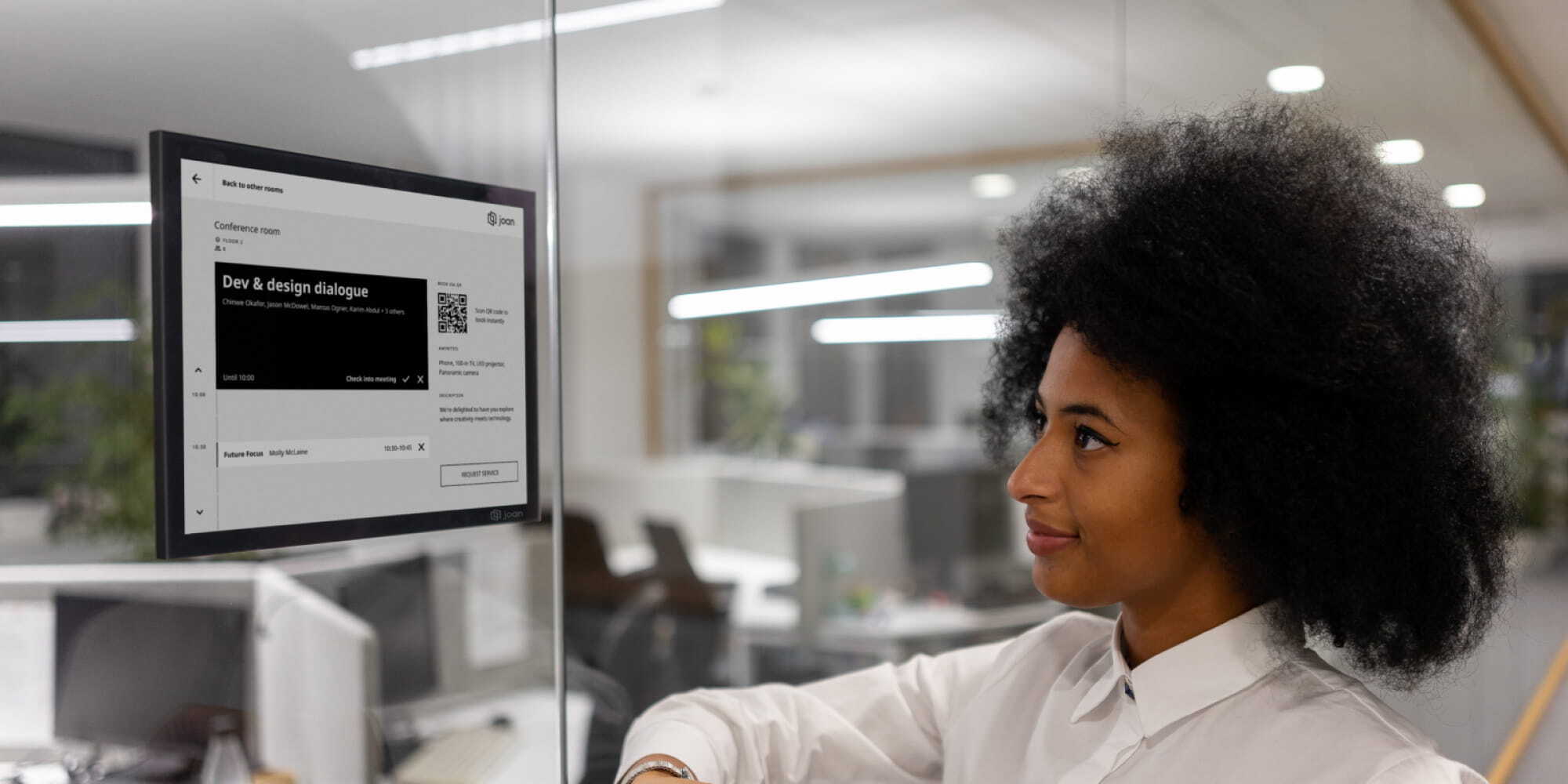
A well-designed display network solves all of this. Room booking screens that update in real time. Wayfinding that adapts to the building's actual state. Lobby displays that communicate the day's agenda rather than yesterday's news. These aren't futuristic concepts. They're deployable today, with technology that exists right now.
These aren't futuristic concepts. They're deployable today, with technology that exists right now.
The gap isn't technological. It's organizational, a failure to connect the right tools to the right spaces.
The "phygital" transition and why it's harder than it looks
There's a word that's been circulating in workplace design circles for the last few years: phygital. The idea is that the physical and digital environments are merging into a single, seamless experience.
It's a useful concept. It's also, in practice, genuinely difficult to execute.
Data security is one of the first challenges organizations encounter. A display network is, at its core, a connected device network. Every screen is an endpoint. Every integration with a calendar system, a room booking platform, or an HR tool is a potential vulnerability. Organizations that deploy display infrastructure without thinking carefully about data governance are creating risks they may not fully understand.
User adoption is the other persistent challenge. Even the best-designed system fails if the people who are supposed to use it don't trust it or don't understand it. This is particularly acute in large, distributed organizations where IT, facilities, and HR all have a stake in how the system works, and don't always agree.
Getting the phygital transition right requires more than good hardware and good software. It requires a genuine commitment to change management, to integration, and to treating the display network as part of the building's core infrastructure rather than an afterthought.
What the future looks like
The corporate environment of the next decade will be defined by its intelligence, not in the science fiction sense, but in the practical sense. Buildings that know what's happening inside them. Spaces that communicate with the people who use them. Displays that surface the right information without being told to, because they're connected to the systems that already know.
Joan is already working toward that future, helping organizations turn their physical spaces into responsive, data-aware environments that support the way people actually work today. For employees, this means less friction and more clarity. For organizations, it means lower costs, better compliance, and a workspace that finally keeps up.
The screen is the interface. Getting it right matters.

Hear it in person - Join us at PIFE 2026
We're bringing this conversation to Birmingham.
On April 29th at 12:00, Miroslav Vučković, Head of Strategic Partnerships at Joan Workplace, will take the stage at PIFE, Pro Integration Future Europe for a keynote on exactly this: how intelligent and sustainable screens are shaping the future of the corporate environment.
The session will cover the evolution of the workplace from static office to dynamic hybrid hub, the tools and technologies making the phygital transition real, and the practical challenges, security, adoption, integration, that organizations need to navigate to get it right.
If you're working in workplace technology, AV integration, facilities management, or digital signage, this is a conversation worth being in the room for.
📍 NEC Birmingham | April 29, 2026 | 12:00 – 12:30
We look forward to seeing you there!
Insights that keep your office running smoothly
Fresh content on productivity, space management, and the future of work. Perfect for managers, admins, and busy teams.
Join thousands of workplace professionals who already read the Joan blog. Unsubscribe anytime.