Here's an uncomfortable number: 64% of workers say they have a better relationship with AI than with their coworkers.
That's from an Upwork survey, and it gets worse. At Anthropic, the company behind Claude, some engineers are now turning to the chatbot for questions that used to go to colleagues. Their own report notes "fewer mentorship and collaboration opportunities" as a direct result.
Remote work changed how people interact. AI is pushing that disruption further. The questions that used to spark thirty-minute conversations now get resolved in thirty seconds with AI.
Efficient, sure. But something feels off.
While productivity might be up in the short term, we're building workplaces where people are more connected to their tools than to each other.
But it doesn't have to be this way. Keep reading, because I'll show you exactly where AI is heading next and how it can actually reconnect your team instead of isolating them further.
The problem: AI tools are isolating your team
I've been watching this play out, and the pattern is almost predictable at this point.
A team rolls out AI tools. Productivity metrics shoot up. Leadership is thrilled. Three months later, someone mentions in passing that the team feels... off. Disconnected. Nobody can quite put their finger on why.
Here's what happened while everyone was celebrating those efficiency gains.
People stopped asking each other questions. Why wouldn't they? AI removed all the friction. No scheduling. No waiting. No risk of looking incompetent in front of a colleague who might judge you for not knowing something basic.
The shift is so gradual you don't notice it until it's done.
Someone uses AI for a simple question they used to toss into Slack. Fine. Then they use it for brainstorming instead of grabbing coffee with a teammate. Still fine. Then for feedback on work that used to spark a thirty-minute conversation with their manager. Each interaction feels more efficient. The cumulative effect is isolation.
The oh sh*t: What happens when efficiency replaces connection
You can't let teams disconnect, even if productivity numbers look good right now.
Two years from now, your team executes tasks faster than ever, but breakthrough ideas have quietly stopped happening. The unexpected collisions between people with different perspectives don't occur anymore because everyone works in their own AI-assisted bubble.
Your best people start leaving. They won't cite loneliness as the reason. They'll talk about "better opportunities" or "new challenges." The real issue is simpler. People stay at companies where they feel connected to their team, not where they have access to the smartest chatbot.
Meanwhile, collective knowledge evaporates. The subtle expertise that separates good work from great work never gets passed down because junior employees learn from AI instead of senior team members who could teach them the "why we do it this way" stories.
When a real crisis hits, your team can't suddenly flip a switch and become collaborative. The muscle memory isn't there. The relationships that create resilient organizations are already gone.
The solution: Building AI as connective tissue, not individual productivity hacks
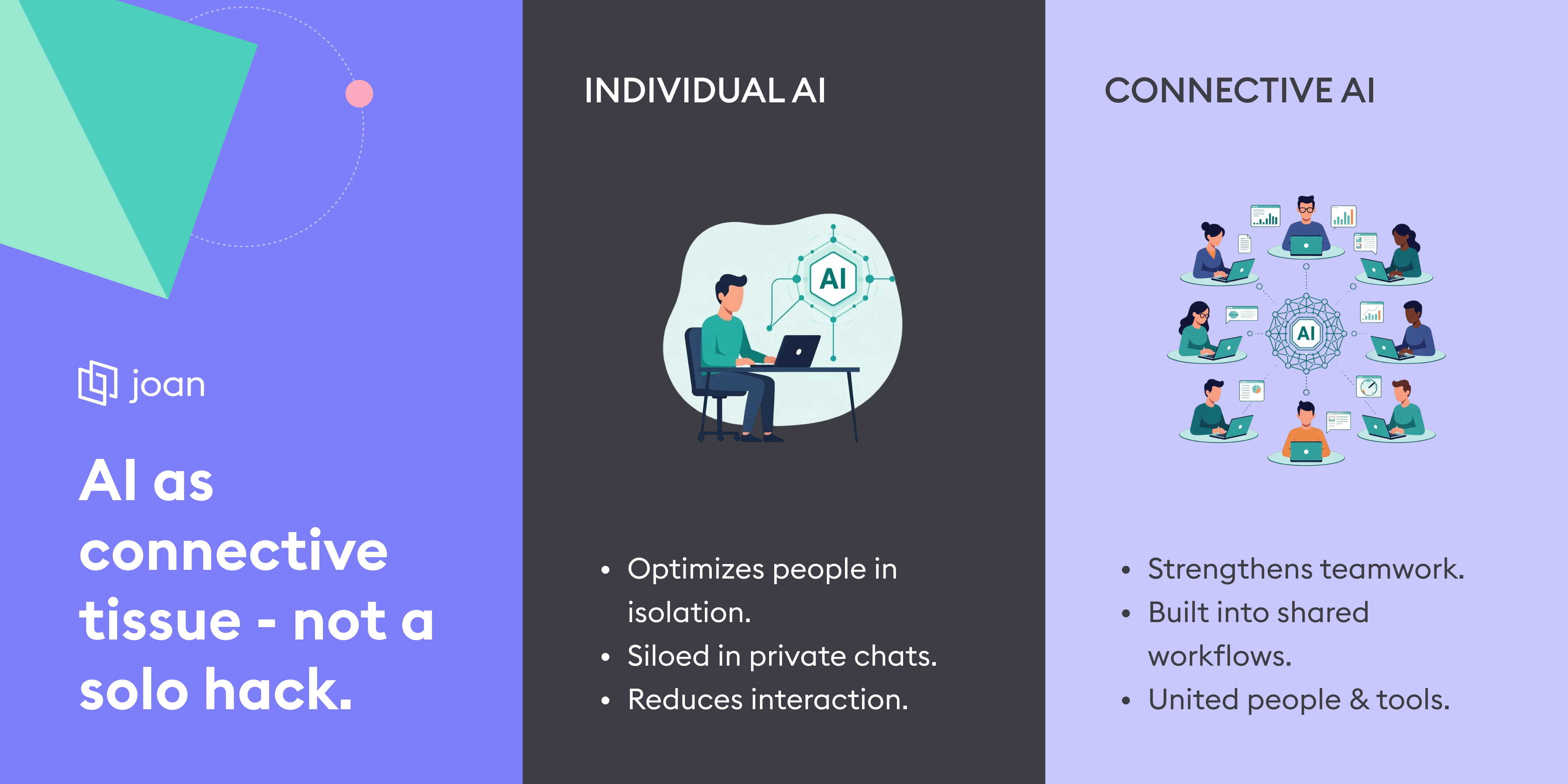
Here's the problem laid out clearly.
AI tools that live outside the flow of teamwork (personal copilots, private dashboards, one-off automations) unintentionally reduce human interaction. They optimize individuals in isolation.
Here's what to do about it.
Embed AI into the systems, conversations, and workflows your team already uses. Focus on tools that help teams stay aligned and see what everyone's working on, not just tools that make individuals faster.
The difference comes down to intent. Are you optimizing individuals working in isolation, or strengthening how people work with one another?
Look for AI that functions as connective tissue rather than a replacement for human interaction:
- Built into your project management tools so everyone sees the same context, not siloed in individual chat windows
- Surfaces patterns across your team's work so people discover they're solving similar problems or can help each other, instead of working in parallel isolation
- Takes care of administrative overhead like tracking decisions, updating project status, and coordinating schedules so teams spend time collaborating on actual problems instead of managing logistics
This works when AI sits inside the infrastructure your team already uses. The rooms they book, the spaces they work in, the natural rhythm of their day. Not another separate tool they have to remember to open.
Want a sneak peek at how we're solving this?
We're building a Joan AI Agent that lives in the workplace coordination systems teams already use. The goal is strengthening how people work together rather than how fast they work alone.
About the author

Insights that keep your office running smoothly
Fresh content on productivity, space management, and the future of work. Perfect for managers, admins, and busy teams.
Join thousands of workplace professionals who already read the Joan blog. Unsubscribe anytime.