I have a bad habit of measuring things too quickly.
Joan makes tools that help people work better. Which means, in a slightly uncomfortable way, we are always being measured against our own product promise. So when AI tools started getting genuinely powerful, not just for basic tasks, but for connecting systems, automating workflows, building things from scratch, there was quiet internal pressure to figure out what that meant for us first.
Gregor, one of our product owners, put it plainly at a team meeting: we should help people actually use these tools, not just talk about them. We ran two workshops, both led internally by colleagues who knew our tools and our daily friction, and then gave teams a full day to put what they had learned into practice.
So when I sat down with our marketing director to talk through how it had all landed, I was half-expecting a rundown of tools built and hours saved.
What she said instead surprised me.
"For me, the biggest wow effect was when someone walked me through the process. I had been doing things in a very limited way. And then they showed me what was possible, and I thought, is this really possible? I had no idea."
She was not talking about a tool. She was talking about what she had believed about herself.
P.S. Let's connect on LinkedIn!
The belief barrier
Your team is not blocked by AI skills. They are blocked by belief, the quiet assumption that building something requires someone else.
Everyone has something. Not vague interest in AI. A specific wish, a process they would improve, a task they have been doing manually for too long, a connection between two systems they always thought someone should fix. These wishes get parked. Not forgotten, just filed under "would need a developer."
Marie works in our operations department. For two years, she manually switched between systems to consolidate data into a summarized report. She knew exactly what kind of tool would solve the problem, but she didn’t think she had the ability to build it herself.
After the workshops, she built it. Not alone, a developer helped guide the technical structure, but the logic, the requirements, the understanding of what it actually needed to do: all of that was hers. She had always had it.
"It's like planting a seed," my colleague said. "You give it the right conditions, and it grows."
The seed was already there. The workshops were just the water.
What the workshops actually did
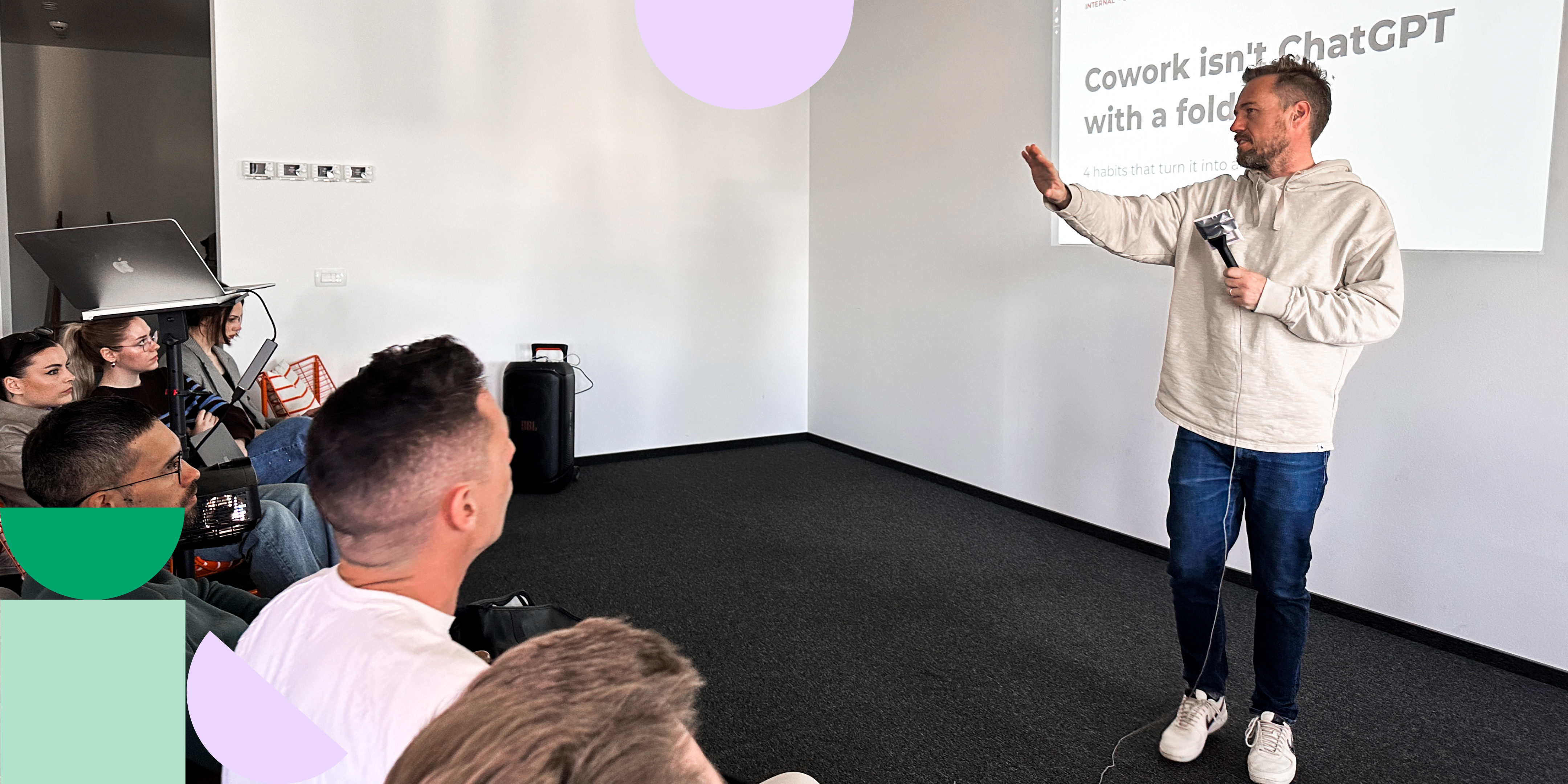
The sessions were led by our own technical colleagues, not an external agency. The people who knew our tools and our specific problems could show what was possible in context. Generic AI training teaches you what tools can do in theory. Colleagues who know your daily friction can show you what they can fix.
What happened in those sessions was what I would call the aha effect. The moment someone realises that a problem they have accepted as permanent is actually solvable, today, without waiting for anyone, something shifts. It is less about the specific tool and more about a revision of what that person believes is possible for them personally. That shift, once it happens, does not reverse.
Taking the ideas further
The two workshops were always designed to lead somewhere. After the second session, we gave teams a full day, a hackathon, to take their ideas from concept to something real. Workshops teach. Hackathons prove.
What came out genuinely impressed me. Not because the projects were technically sophisticated, but because every team brought something they actually needed. These were not solutions in search of problems. They were items from the parked list, finally addressed. Every team presented something that could be used the following Monday.
What this means for your time
There is something worth naming that rarely comes up in AI adoption discussions: what happens to the time people get back.
When someone automates a process that used to take three hours a week, they have three hours. The instinct in most companies is to fill it with more work. We think about it differently.
The time you gain from working more efficiently is genuinely yours to decide what to do with. Some will use it for deeper work on harder problems. Others will use it for things that have nothing to do with work. Both are fine. Both are the point. The workshops were never just about productivity; they were about giving people more capability over their own time.
The parked list does not go away on its own
It just gets longer, and people learn to stop noticing it.
What I saw at Joan is that when you create the right conditions, internal expertise, unstructured time, no predetermined output, people do not need to be told what to build. They already know. They have always known.
The question is whether you are giving them the space to find that out.
P.S. You can follow my product, sustainability, and workplace insights on LinkedIn. Let's connect!
About the author

Insights that keep your office running smoothly
Fresh content on productivity, space management, and the future of work. Perfect for managers, admins, and busy teams.
Join thousands of workplace professionals who already read the Joan blog. Unsubscribe anytime.