You ever have one of those days where you know exactly what you need to get done?
You're driving to work with a clear plan. You're going to tackle that project that actually requires thinking. You've got the mental space for it.
Then you arrive. A teammate asks which room has the working projector. Your phone buzzes with a personal thing you need to handle. Someone can't find the HDMI cable. Can you approve this real quick? The coffee machine's acting up and you're somehow the person to ask about it.
Five small things. Maybe ten minutes each.
You're driving home and realize you did nothing you set out to do. The focused work never happened.
Our offices are bleeding focus in these tiny moments, and the cost never shows up on any budget report.
The 25-minute problem nobody talks about
In her book Attention Span, psychologist Gloria Mark found something uncomfortable. When you get interrupted, it takes 25 minutes to bring your attention back to a task.
25 minutes.
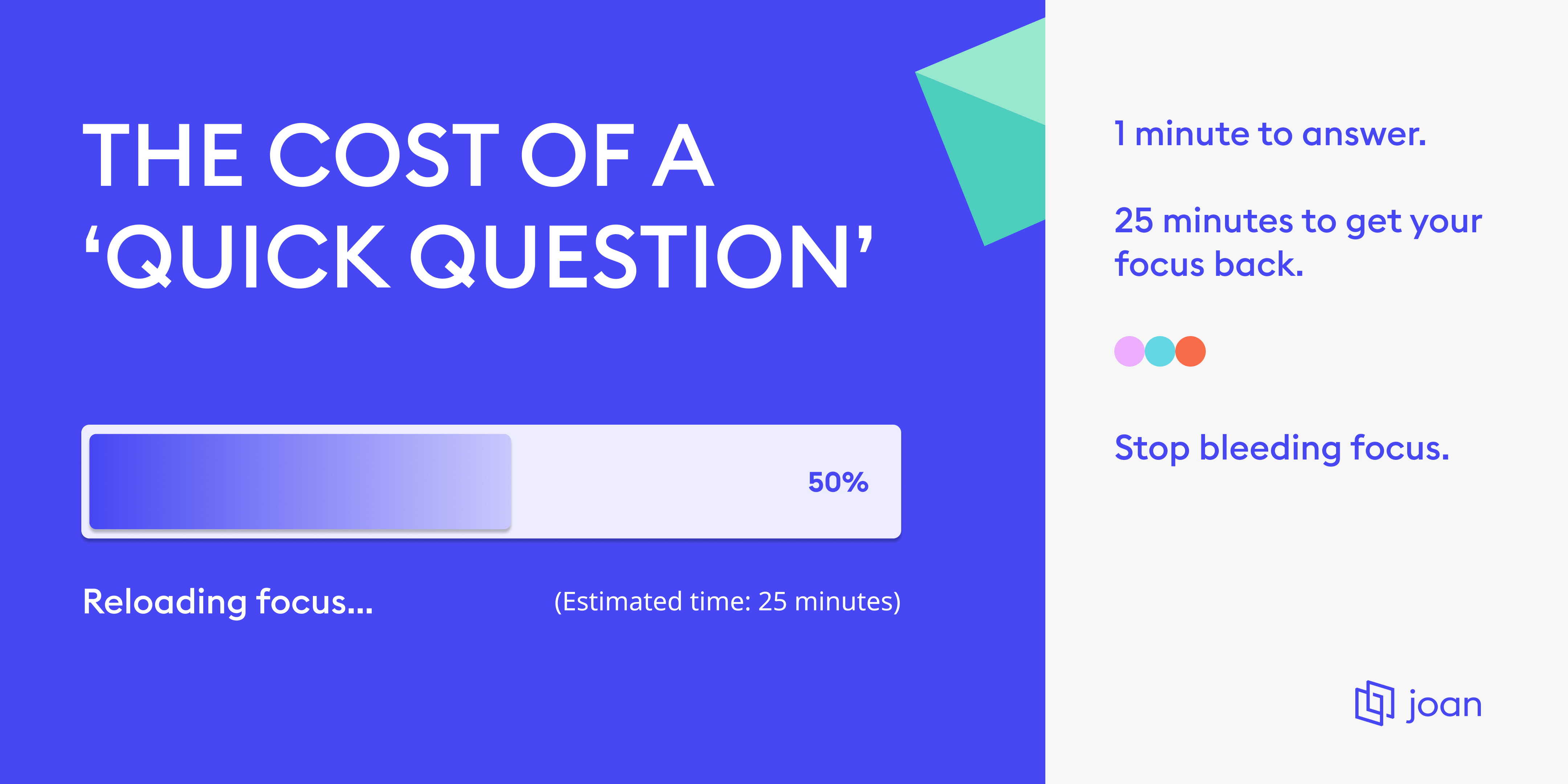
People assume this is about laziness or poor focus. It has nothing to do with either. This is how human cognitive architecture works. Your brain needs time to reload context, rebuild the mental model, and get back into flow.
The modern office pretends this isn't real. We design workplaces where searching for a working HDMI cable or figuring out which meeting room is actually available counts as "just a quick thing."
Except your brain doesn't have a quick resume button. Every time someone gets pulled away to deal with office logistics, they lose the interruption time plus the 25 minutes it takes their brain to reload where they were.
The math gets ugly fast.
What friction actually costs
I sat down with a calculator because I wanted to know what this looks like at scale.
The scenario:
- A company with 1,000 employees.
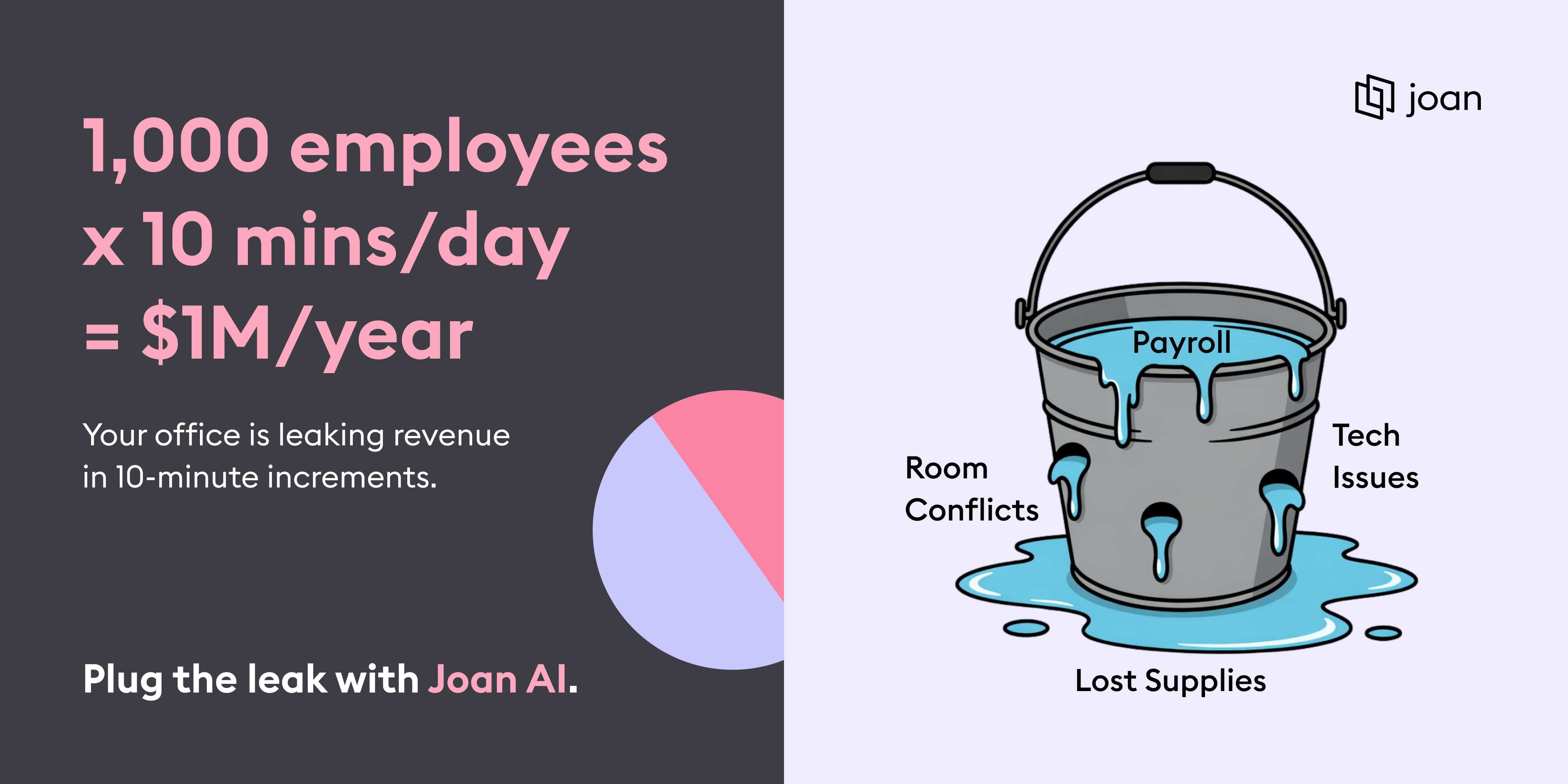
- Each person loses 10 minutes per day to office logistics (booking rooms that turn out to be occupied, tracking down supplies, troubleshooting equipment).
The math:
- 10 minutes per person × 1,000 employees × ~250 working days = roughly 40,000 hours per year.
- That's 40,000 hours of payroll spent hunting for staplers and resolving room booking conflicts instead of actual work.
The hidden cost:
- Add the 25-minute recovery tax every time someone gets interrupted, the real damage happens to deep work.
What you're actually losing:
- Your designer can't bill clients for the hour she spent troubleshooting a locked conference room.
- Your engineer's breakthrough idea that got derailed when someone asked where the spare cables are kept never makes it into the product roadmap.
The opportunity hiding in plain sight
What if you could recover even half of those lost hours?
20,000 hours per year. For a 1,000-person company, that's roughly $1 million in payroll currently spent on office logistics instead of revenue-generating work.
But here's what matters more. What your team could actually accomplish with that capacity back. Your product team could ship features faster. Your sales team could close more deals. Your leadership could think strategically instead of firefighting operational noise.
The teams I've seen make this shift describe something specific. They stop feeling like they're fighting their environment. The background static of office logistics just goes away, and suddenly there's space for the work that actually moves the business forward.
And in the era of AI agents, there's finally a way to make this happen without adding more work to anyone's plate.
Why AI agents, not another tool
Most companies try to fix this by adding more systems. Another app for room booking, a solution for parking reservations, a Slack channel for office questions.
The problem is that every small thing still needs a human to notice it, think about it, and handle it.
We're in the era of AI agents, and this is exactly the kind of work they're built for. Not replacing people, but handling the small, repetitive coordination tasks that pull focus away from real work.
Imagine this. You need a meeting room for 2pm. Instead of checking three different systems, finding out the room you booked doesn't have the equipment you need, and searching to find an alternative, an AI agent already knows what you need. It books the right room, confirms the setup, and flags any conflicts before you even think about it.
We've been building this at Joan. An AI agent that manages workplace coordination in the background. Room conflicts get resolved. Equipment issues get flagged. Schedules get coordinated. Your team just works, and the logistics handle themselves.
The goal is making friction invisible so your team can focus on work that actually grows your business.
Early access to Joan AI
We're opening up early testing for the Joan AI Agent soon.
The system works within Joan's workplace coordination platform. It handles booking, troubleshooting, and logistics through natural conversation.
If you want early access before we open it up widely, reply to this email. I'm looking for companies who are serious about plugging the cognitive leakage and can give honest feedback on what works and what doesn't.
This is about getting that capacity back for your team.
About the author

Insights that keep your office running smoothly
Fresh content on productivity, space management, and the future of work. Perfect for managers, admins, and busy teams.
Join thousands of workplace professionals who already read the Joan blog. Unsubscribe anytime.