At our company, finance Slacked me recently:
“Do you know what this $847 invoice is for?”
I didn’t.
Unknown vendor. No contract. No pricing reference. A PO nobody could trace.
Turns out someone ordered desk lamps from a supplier they found on Google three months ago.
Nothing dramatic.
Just how most workplace procurement still works.
Manual research. Email approvals. PDFs. Human memory acting as system glue.
Now zoom out.
At their 2025 IT Symposium, Gartner predicted that by 2028, 90% of B2B buying will be AI agent–intermediated, driving over $15 trillion in spend.
Most people interpret this as:
“Procurement teams will get AI tools.”
That’s not what this means.
This means the interface of commerce is changing.
The buyer is no longer a person
For decades, enterprise software was built around a simple assumption:
A human logs in.
A human searches.
A human compares.
A human approves.
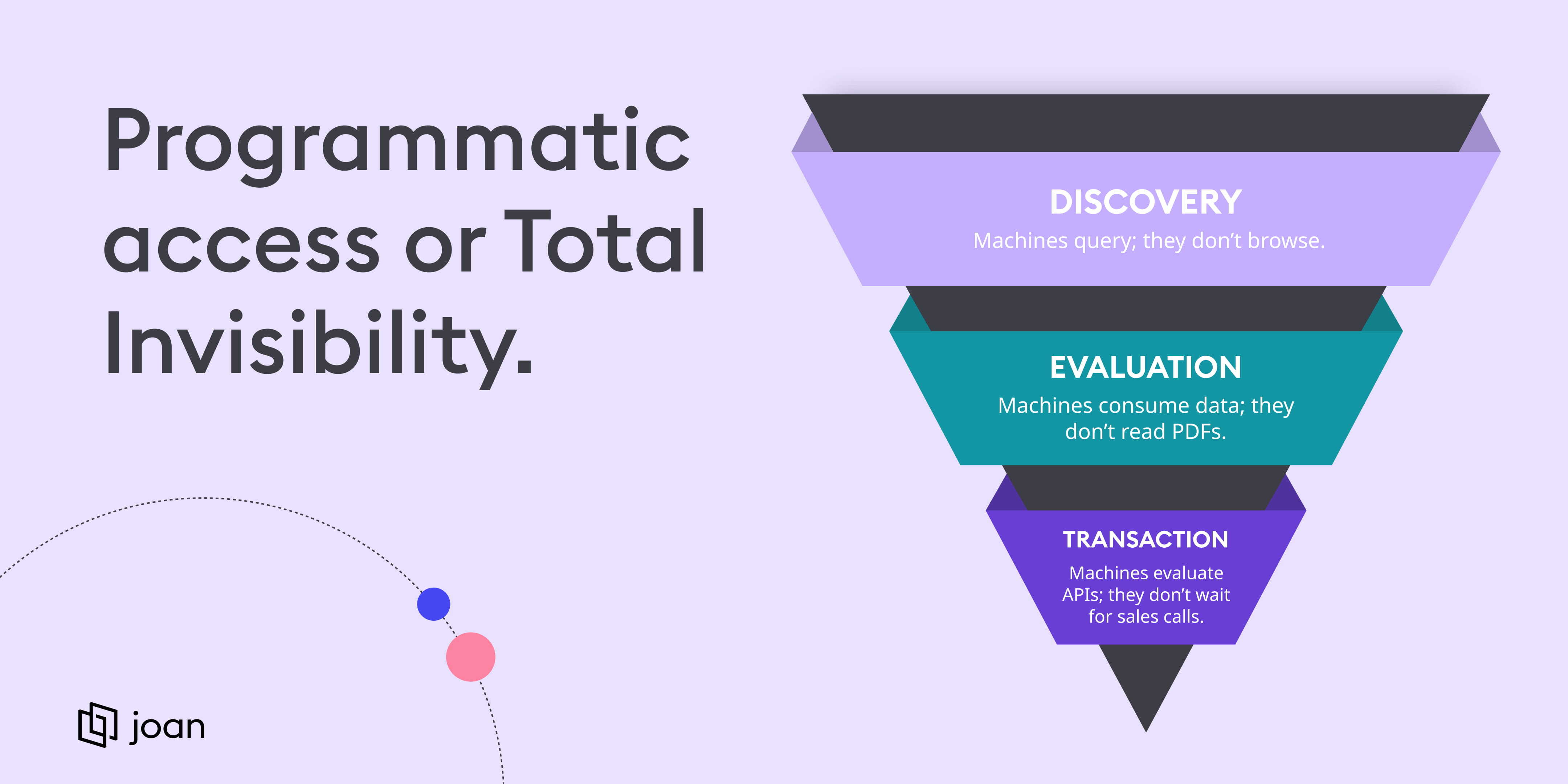
But AI agents don’t browse.
They query.
They don’t read PDFs.
They consume structured data.
They don’t wait for sales calls.
They evaluate APIs.
If an agent can’t programmatically discover, evaluate, and transact with you, you are invisible in an AI-mediated economy.
That’s not a feature gap.
It’s an infrastructure gap.
This is a workplace leadership issue
This shift isn’t just about procurement.
It impacts how the workplace itself operates.
Think about what HR, IT, and workplace teams manage every day:
- Room bookings
- Equipment provisioning
- Hybrid scheduling
- Contractor onboarding
- Space allocation
- Visitor access
- Policy approvals
Today, these are workflows executed through dashboards, forms, emails, and coordination.
Tomorrow, many of these actions will be triggered by autonomous systems:
- An onboarding agent provisions a desk, laptop, and room access.
- A planning agent books 12 rooms for quarterly strategy sessions.
- A cost-optimization agent reallocates underused space.
- A procurement agent negotiates and places equipment orders within policy limits.
The question isn’t whether this will happen.
The question is whether your workplace infrastructure can respond to it.
Machine-readable or marginalized
AI agents require:
- Structured, machine-readable data
- Real-time availability
- Policy engines, not PDF rulebooks
- API-level access
- Automated approvals and audit trails
If your workplace systems depend on:
- Manual coordination
- Human interpretation of policies
- Static spreadsheets
- “Contact admin” bottlenecks
…they become friction in an autonomous enterprise.
As a CTO, this is the real shift I see:
We’re moving from software designed for interaction
to infrastructure designed for orchestration.
That requires different architectural thinking.
Identity and access control must be agent-aware.
Audit trails must handle autonomous decisions.
Policies must be codified, not explained.
Systems must expose structured capabilities, not just user interfaces.
This is not an AI feature roadmap.
It’s a systems redesign conversation.
Procurement doesn’t disappear. It evolves.
The narrative that “procurement teams will vanish” is simplistic.
What disappears is manual orchestration.
What expands is:
- Policy design
- Vendor governance
- Risk modeling
- Oversight of autonomous transactions
- System interoperability
Procurement becomes less about chasing invoices and more about defining the rules agents operate within.
That’s a higher-leverage role.
But only if the underlying systems are built to support it.
Why we’ve been thinking about this for years
At Joan, we didn’t start with “How do we add AI to room booking?”
We started with a different question:
What would workplace infrastructure look like if the primary consumer wasn’t a person, but a system?
That changes design decisions.
Meeting rooms become structured inventory.
Equipment availability becomes queryable.
Scheduling conflicts become resolvable via policy engines.
Space data becomes machine-interpretable.
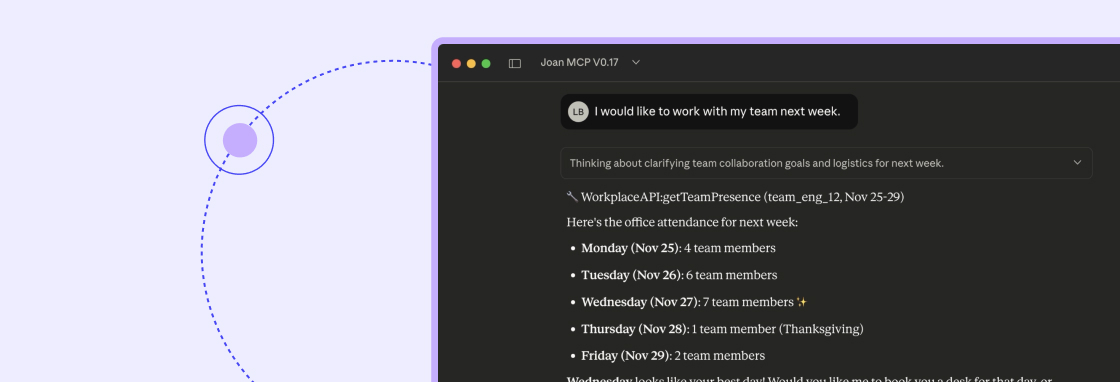
In that world, a planning agent doesn’t “log in.”
It interacts with infrastructure.
That’s a fundamentally different mindset from building better dashboards. Here's how we did it.
The real strategic question
The $15 trillion shift to agent-intermediated commerce isn’t just about vendors selling to AI.
It’s about enterprises operating through AI.
We spent the last 20 years optimizing click paths.
The next decade will optimize coordination between systems.
So here’s the uncomfortable leadership question:
If tomorrow your employees were supported by autonomous agents instead of manual workflows…
Could your workplace systems keep up?
Because in the agent-first enterprise, the bottleneck won’t be people.
It will be architecture.
See you in the next one,
Luka
About the author

Insights that keep your office running smoothly
Fresh content on productivity, space management, and the future of work. Perfect for managers, admins, and busy teams.
Join thousands of workplace professionals who already read the Joan blog. Unsubscribe anytime.