Something changed in the last few years and I don't think enough people have named it. Sustainability went from being a differentiator to being a requirement.
The companies I'm talking to now aren't impressed that Joan is sustainable, they expect it. And they are serious about it. Some of our customers have entire teams dedicated to sustainability: real budgets, real commitments, real accountability. People whose entire job is making sure the business actually lives up to its values.
So it caught my attention when those same companies would walk me through their office and point to everything they'd improved, while a thermal printer at reception churned out badges in the background. Same as it always had.
Not because nobody cared, but because there was no better way to do it.
P.S. Let’s connect via LinkedIn!
The problem was never the intention
Visitor management systems have always come with a printer. That's just how it worked. You bought the software, plugged in the printer, ordered the badge rolls, and someone somewhere was responsible for making sure it didn't run out on the wrong day.
I recently did the math:
20visitors/day x 250 working days/year = 5,000 printed badges/year
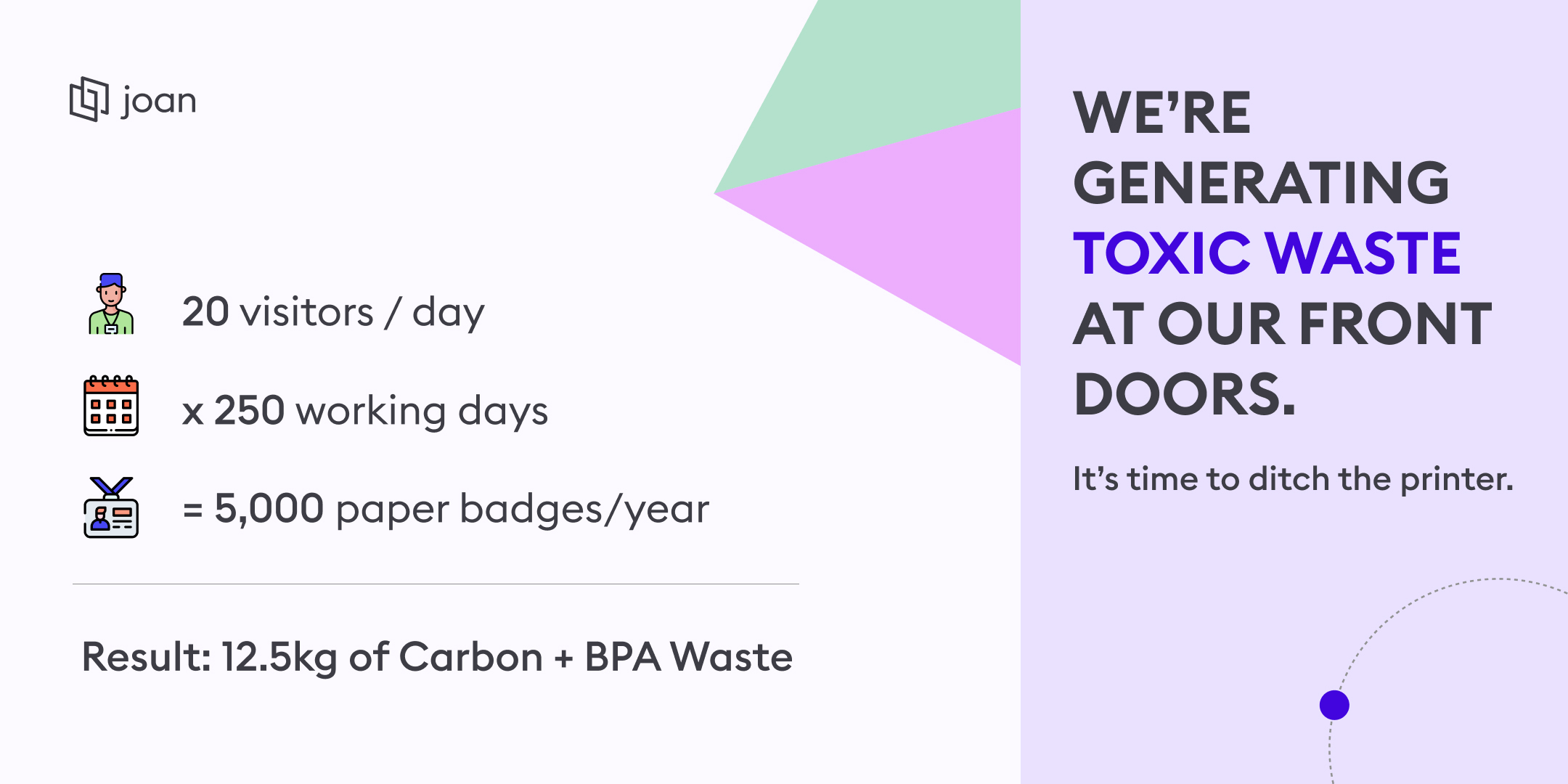
With 2.5g carbon emissions per paper badge, that adds up to 12.5kg of carbon just from visitor check-ins, before you've counted the ink, the packaging, or the printer itself. And we’re not even counting busy days, company-wide events, or client on-sites.
But the bigger issue isn't the carbon, it's what happens after. Thermal paper isn't recyclable because the BPA coatings that make it heat-reactive also make it a contaminant in the recycling stream. When it doesn't get recycled, it goes to landfill and leaches chemicals into the soil.
So companies with genuine sustainability commitments have been generating a toxic waste stream at their front door, not out of negligence, but because nobody had built a real alternative.
P.S. You can see the ROI for your office via this calculator.
Sustainability isn't just about the numbers
The customers I've talked to who care most about sustainability aren't leading with carbon calculations. They're thinking about culture and what values they signal to visitors, to partners, to the people they're trying to hire.
And the urgency is real, most large organizations are now targeting net zero waste goals within the next decade, which means diverting 90% of waste from landfills. If that's your goal, your reception desk is currently working against you.
And then there's the cost nobody's calculating.
Paper feels cheap until you add up everything around it: the person managing supplies across multiple locations, the printer that jams at exactly the wrong moment, the reordering, the maintenance, the small operational fires that nobody officially owns. That overhead is real, it's just never on the same line as the paper cost.
There's a gap that exists in a lot of companies right now, between what the website says and what people actually see when they walk through the door. That gap gets noticed, maybe not consciously, but it does. The small things are where values become visible, and reception is one of the smallest things that's also one of the first.
So we built the alternative
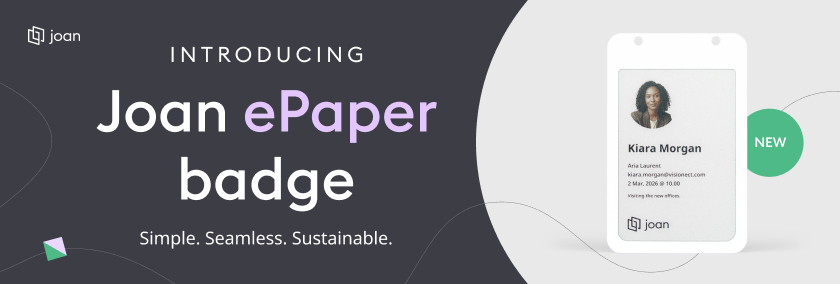
We removed the printer entirely. Joan ePaper badges are a one-time purchase, connected to the visitor management system via Bluetooth, and reused by every visitor that walks through your door from that point forward. No consumables, no waste stream, no badge rolls to reorder.
The display is four-color, high resolution, readable in any lighting, and updates instantly the moment a visitor checks in. It runs on a single charge for extended periods, so there are no cables at reception either.
When people see it, they get it immediately, not because we explained the carbon math, but because it's the first badge that actually matches the values on the wall behind it. It's not about recycling better. It's about removing the waste stream entirely.
The reaction has been something I genuinely didn't expect. Companies are reaching out asking when they can get their hands on it, not because it's the most impressive piece of technology they've ever seen, but because it solves something they'd accepted as unsolvable.
The signal you're sending before anyone says a word
There's another moment worth thinking about that doesn't show up in any sustainability report. The job candidate who walks in for an interview. They've researched the company, they've read the website, they know what you stand for. And then they get handed a thermal paper badge and pointed to a sign-in book.
It's a small thing. But small things land differently when someone is deciding whether they want to work somewhere. The people worth hiring in 2026 have options. They're not just evaluating the role, they're evaluating whether the company actually lives its values or just talks about them. And they're making that assessment from the moment they walk through the door, before the interview starts, before anyone has said anything impressive.
A reusable ePaper badge isn't going to close a hire on its own. But it contributes to an impression that's either coherent or isn't. Either the office feels like a place that takes its values seriously, or it feels like a place where values live on the website and nowhere else. That gap is smaller to close than most companies think, and reception is one of the first places to start.
The gap is smaller than you think
Closing the distance between a sustainability commitment on paper and one people can actually see doesn't require a big initiative or a task force or a budget approval that takes six months. Sometimes it just requires questioning something that everyone assumed was the only way.
The printer at reception wasn't the problem. The lack of an alternative was. That alternative exists now: Joan ePaper badges
See you in the next one, Luka
P.S. I’m quite active on LinkedIn sharing insights on workplace tech and sustainability. Let’s connect here so we can keep the conversation going outside the inbox.
About the author

Insights that keep your office running smoothly
Fresh content on productivity, space management, and the future of work. Perfect for managers, admins, and busy teams.
Join thousands of workplace professionals who already read the Joan blog. Unsubscribe anytime.